fashion e-commerce
startup on pre-seed ($5m)
 Try Fitme Prototype
An AI-driven apparel fulfillment marketplace with virtual fitting in motion
WHY NOW?
Post-Covid-19, consumer habits have
dramatically shifted toward digitization.
People now view their mobile phones as
the ultimate source for everything —
even ordering food.
A commercially validated trend:
the personalized approach.
Soaring compute power, a bandwidth explosion
and remarkably clever AI are converging
to unlock a fundamentally new way to shop
on a global scale: futureshopping as it is
(an allusion to A. Toffler).
Access to fervently committed, top-tier talent,
ready to overdeliver.
The idea has been in the air for a long time,
but so far no one has done it right.
Competitor readiness? Suffice it to say, there isn’t
a single commercially viable solution in the live,
in-motion virtual try-on space (despite appearances, perhaps?).
See Exit Strategy for more details.
Team
Ceo

Author and Visionary — Vitaly Borshchevsky.
Born in Saint-Petersburg, Russia.
Moved to Israel in 2020; now living in Tel-Aviv.
Developed a business with $40M+ in revenue,
customers in Forbes (Ulmart with $1B sales).
Education: software developer (since 9 yo),
designer, neuropsychologist.





Brains
The team consists of professionals with
extensive experience in AI, e-commerce
and computer vision. They have delivered
projects for companies such as LG Electronics,
Daimler-Chrysler, Cisco and others.
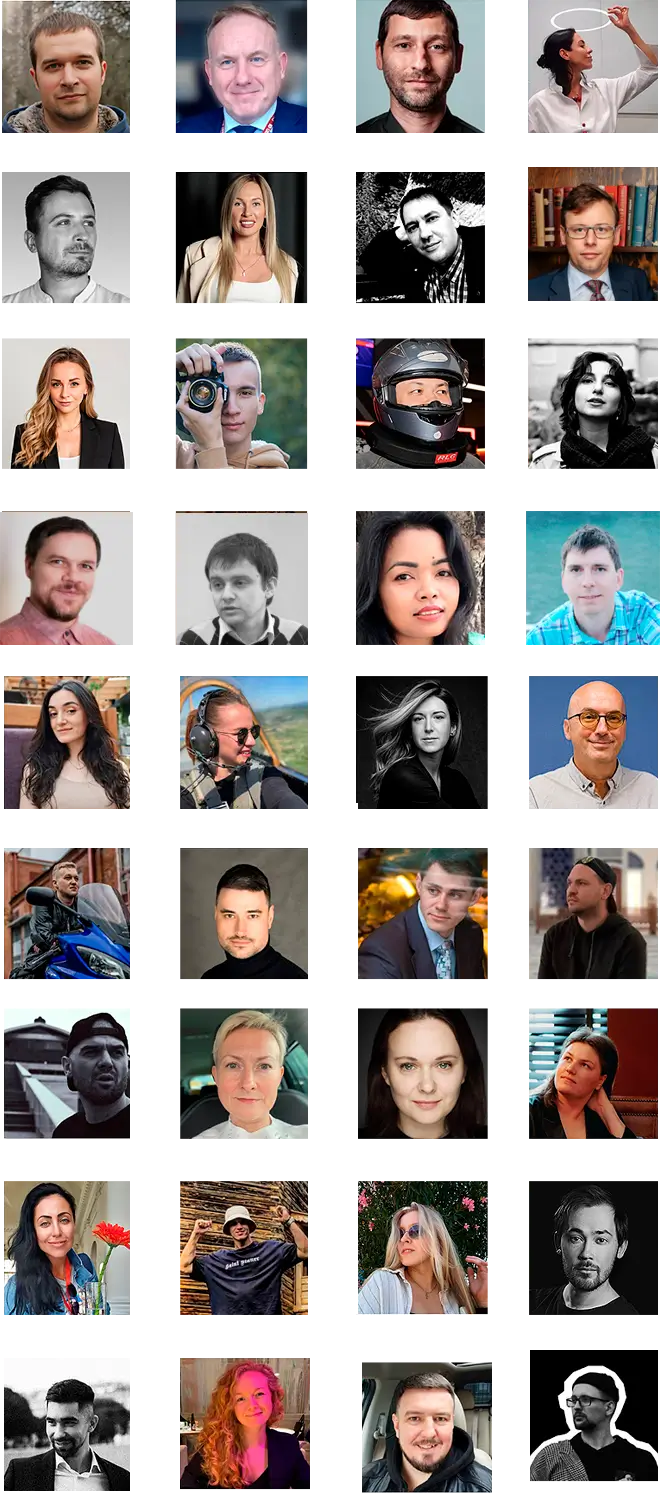
I have been working with many of them since
2006 and together we have implemented more
than 100 projects across various fields.
I also maintain strong ties with universities
in Russia, giving us access to talented young
students in math, programming, physics
and optics fields for the needs of capitalism.
Why others still couldn’t create virtual fitting in motion but we can? Proofs!
Yes, the technology is still complicated to build
a full solution according to real physical properties
of the body and clothes (fitting takes physical sizes
into account, not just pixels like common AI):
- capturing human body and face details with a regular smartphone;
- digitalizing clothes with all properties and behavior on different body shapes;
- understanding the physics of body and fabric;
- dealing with the layers of clothes;
- taking into consideration different styles based on user’s cultural references and big data;
- fast generation and delivery of video to the end user — at the scale of millions of users.
The key issue for today is physics — reality.
There are some available solutions that can swap
your clothes in a photo (Google, Kuaishou, etc.),
but such software does not take into account
the real sizes of clothes, human body metrics
and their mutual behavior.
See some projects done by our team members
to indicate the ability to create futureshopping.
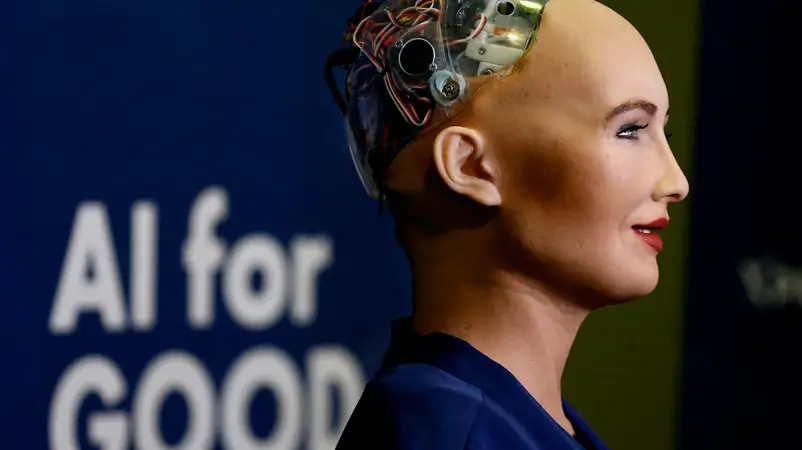
AI-CORE for Sophia ROBOT
The first humanoid robot with citizenship!
Our core team has worked for
SingularityNET and Ben Goertzel to create the
"brain" for Sophia: SAI itself.

Computer vision projects:
-
360-cameras to analyze the surroundings
of Sophia, the ability to identify and recognize
multiple interlocutors, understand their
emotions, mood and intentions for a deeper
conversation. -
AI-solutions for fully automated area control:
people, actions, access, vehicles and cargo with
a precision up to 99.37% in prediction. NDA. -
 Packaging defect identification
system for Unilever production
in low and unstable light
conditions. -
Computer vision for medical diagnostics:
Integration into mobile applications
and endoscopes for otolaryngology (ENT)
with MRI image analysis. NDA. -
Drone-based monitoring and environmental
assessment of forest plantations. NDA. -
 Research of WinCC OA platform functional
capabilities for distributed systems
implementation and external modules
integration for Siemens. -
 Development of a low-cost
high-efficiency computer vision
system for robotic vacuums. -
Development and implementation of a computer
vision module into the production process for
e-commerce expertise
30+ major online players with different business
models, across diverse sectors, including:
- Electronics & home appliances
- Construction hypermarkets
- Automotive parts
- Tools
- Medicine (b2b)
- Children’s toys
- Adults’ toys
- 2 leading marketplaces with 300,000 daily visitors
Full business process automation.
End-to-end website development & maintenance.
Digital advertising campaign management.
Blumart — Europe’s largest plumbing and tile retail
chain, Moscow.
Transformed operations after 8 years of legacy
processes. Process automation, optimization
and innovation implementation.
Scaled from 1 store → 5+ hypermarkets (35,000+ m²
total). 7.5x monthly sales growth since partnership
began. Yearly revenue growth of 50% culminating
in $40M annual sales.

With strategic investment (far below contemporary
art prices), our fusion of AI, computer vision,
e-commerce expertise and passion can fast-track
the futureshopping.
The investor I’m looking for

A bored billionaire
— that sums up, in a nutshell, the ideal FITME
investor. Someone with whom we will
revolutionize a $5 trillion market, fundamentally
reshaping both traditional fashion retail
and e-commerce, and finally delivering to users
worldwide what they, even without realizing
it, have been waiting for — futureshopping.
Various institutional funds — risk-averse
and confining ideas within rigid scoring
frameworks — just think of Skype, Airbnb,
Dropbox, Twitter, WeWork, Zoom, Spotify, etc.
Also to be excluded: state funding — a person
with a Russian background, lacking an MBA
or an Ivy League diploma, will likely appear
unfamiliar and opaque to you.
But I’d be glad to be proven wrong — Contacts.
Guided by the maxim that I’m not a dollar bill
to be liked by everyone, I’m specifically looking
for commercial entrepreneurs as partners.
Individuals motivated not primarily by money
(which you likely already have), but by
something else. An indefatigable desire to create
something large, compelling and complex —
something that dramatically alters the status quo
in a $5 trillion market.
As a slightly modified Diesel slogan aptly puts it:
“Only for the brave.”
FITME — Not Just Apparel
Clothing retail is merely the first attractive
opportunity to monetize the breakthrough
technology of merging human models with
real-life objects.
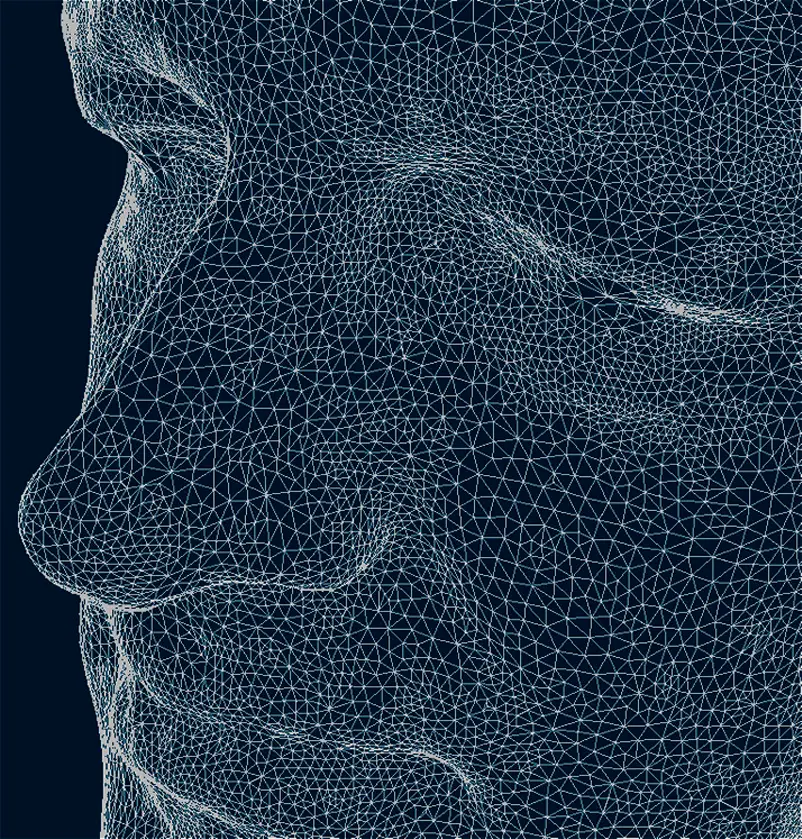
This technology of strong and specialized artificial
intelligence can easily be expanded into other
industries, not necessarily retail-adjacent, such as:
- medicine and cosmetology;
- design;
- security (just think about it more broadly);
- video games;
- filmmaking;
- consumer goods, marketing (big data), etc.
Collaboration with social media and the mutual
integration of digital avatars offer vast marketing
opportunities (any Meta-universe).
It may not yet be the right time to predict
the profit potential of licensing this technology,
but there’s no doubt that the potential is there.
FITME Contacts


Schedule 30-minutes appointment
Little notice:
I don’t prioritize social media engagement,
so you likely won’t find much of interest there.
Prefer to reshape reality.
Summary for Investors
FITME — the biggest AI-driven apparel fulfillment marketplace with virtual fitting in motion
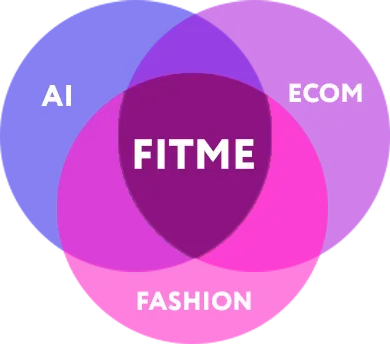
As the product of three major domains intersecting, what problem does it solve?
1. Futureshopping.
Provides a new way of consumption that meets the
expectations of today’s users. In the race for
audience attention and retention, this is even more
important than anything else.
2. Reduced returns.
When shopping for clothing, finding items that fit
well can take a lot of time. And even after making
a purchase, people often end up having to wear
a badly-fitting item or make a return.
In offline apparel retail, the average return rate
reaches 8%, and goes up to 30% in online retail.
The solution — FITME
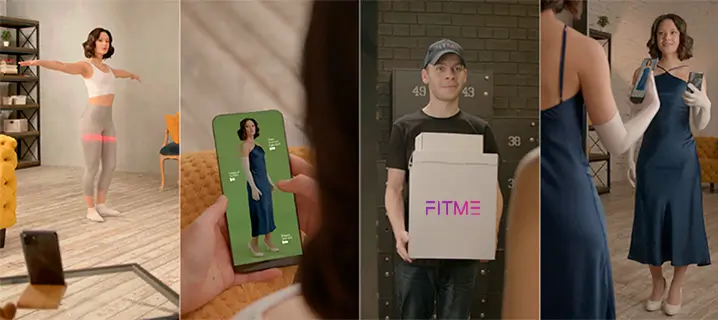
Using FITME, customers are able to define the
style, budget and brands across a large variety of
clothes, see themselves in motion while virtually
wearing various clothing options with
an unprecedentedly high level of fitting accuracy.
This is a deeply specialized artificial intelligence
focused on clothing (layers), the behavior
of fabrics, measuring the human body and working
as a first-class stylist based on big data, which
makes our marketplace unique and more advanced
compared to its counterparts.
global market
$ 5,000,000,000,000
Every online buyer on Earth spends avg. $1000
per year on apparel shopping, which includes
clothes, footwear and accessories.
The revenue of the global apparel market is
estimated at $2 trillion for online and $3 trillion
for offline (STATISTA) = 5 trillion dollars market,
it’s a really big game and we are going to do here
a big revolution for current majors.

FITME financials projections
The aim: Unicorn status within 4 years post-launch.
See Downloads for detailed financial projections.
2M
31M
253M
1B
2B
investment sought
The R&D phase — that is, the development of a stable personal virtual try-on-in-motion technology, which could potentially be used as a B2B SaaS product — will require just
$5M over 9 months.
A modern apartment in Tel-Aviv is more expensive!
After we create the stable technology, we will need much more money:
for marketing and infrastructure to create
the largest marketplace (warehouses, personnel,
process automation, integration with factories).
The marketing budget greatly depends on which
market to launch in.
Launching in the U.S. (New York) will require
a different scale compared to testing in smaller
markets like Singapore, Hong Kong, Bangkok
or even Israel.
If it sounds too risky for you, please go over
the section "The investor I’m looking for"
to optimize our time.
download
FITME investment documentation — varying
levels of detail, distinct from the website content.
These files provide a completely different
perspective on the investment opportunity,
packaged in formats of increasing scope.
We recommend reviewing the materials
in the following order:
FITME in 1 page — executive summary (one-pager)
10-page PDF — essential information for a
comprehensive understanding: technology (how),
team (who) and financials (how much).
30-page PDF — detailed business plans, 5-year
projections, charts, market statistics, competitive
landscape, in-depth technical explanations,
team profiles, and exhaustive commercial models.
Developed in partnership with the Ministry
of Aliyah and Integration (Israel).
Download all documents — ZIP-archive
YouTube 1.5 minutes video
Prototype to try the technology now
Share this web-site
Important: Financial figures may be outdated.
Serious inquiries are encouraged to contact us
directly.
Exit strategy
With a stable technology for fitting clothing onto
a person's digital avatar in motion, there are
at least two obvious scenarios for its application.
Let's start with the most boring one.
1. B2B SaaS white-label for e-commerce fashion brands — the solution integrates into websites and apps, allowing users to try on a manufacturer's catalog on themselves and see themselves in real-life contexts wearing the product. Solid, yes — but the scale isn't exactly thrilling.
2. FITME as a global play (B2C) — a brand-new, largest-scale online clothing store / marketplace (the hybrid model), powered by this still-unique, reliable virtual try-on technology with an AI stylist in the pocket. This is exactly what the title of this presentation is about:
a futureshopping clothing store offering a truly innovative hyper-personalized customer
shopping experience. And we win over an audience with our killer features.
While running either model and generating revenue — and watching the appetite of major players grow — we keep the bigger picture in mind.
Making money from this business is great, but at a certain level of visibility, acquisition offers for the core technology tend to show up — from the likes of Amazon.
And if an attractive offer lands on the table... why not entertain it?
 Amazon isn’t just a hypothetical acquirer.
Back in 2017, it acquired Body Labs
specifically to develop similar virtual try-on
capabilities.
The acquisition price of Body Labs,
a company built with $2M, was $70−100M.
It’s now 2025, and neither Amazon nor any other
player possesses a functional solution for virtual
apparel try-ons, especially in motion.
(Notably, Body Labs’ founders are sitting on
at least $68M in cash)
 A similar story occurred with another major.
In 2021, Walmart scooped up the Israeli startup
Zeekit (!שלום חברים). The deal’s price tag hasn’t
been officially spilled by Walmart, but Haaretz
pegged it at around $200M, with the startup raking
in up to $16M in investments beforehand (now
compare that with what is required to build FITME).
But here’s the kicker — Walmart still hasn’t rolled
out any virtual try-on with motion, and it’s been
years already.
All this highlights several compelling realities:
There’s money in the air — the market
shows persistent interest in virtual
apparel try-on technology.
The technology is intricate.
It's a deep dive into high-tech.
Top-tier talent is essential.
We modestly assert that we have this
covered and are confident of success.
Time is of the essence.
Once a major player successfully
develops something similar,
subsequent marketing costs will increase.

It’s better to move fast. So why now?
So, what do we have?
-
There’s still room in the market for a high-tech
clothing operator offering a revolutionary
customer experience; -
A ready product solution for automating
of a global, high-transaction e-commerce
business; -
3D human-modeling technology is already
available, we just need to adapt it to our needs;
-
The prototype of virtual fitting in motion
and you can Try FITME Prototype right now; -
An ambitious team — Israeli/Russian
mathematicians, programmers and marketing
specialists with international experience; -
Vitaly Borschevsky, an Israeli citizen,
at the forefront of the development team.
Combining the above will allow us to create
another revolutionary Israeli startup.
After 2023.10.07 many investors have postpone
their investments in Israel, but today, especially
after Trump-47, the investment climate
in Israel is much better now, isn’t it?

What do we need?
To develop the technology for mass
digitization of any clothing, footwear
and accessories, which will then be
quickly merged with a high-quality
moving digital avatar of a person.
Every word matters.
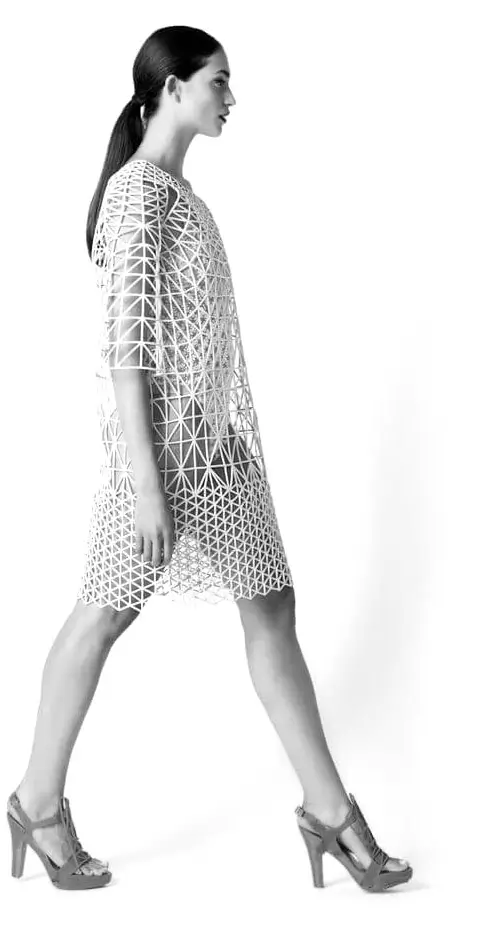
This is the purpose of the initial investment —
development the fully functional technology
the mass 3D-merging of clothing (broadly
speaking) with a human body.
There are two main approaches to achieving this:
mathematics and AI.
And, of course, a combination of both.
Technical details can be found in the Download.
We estimate that this phase will take up
to 9 months and $5M. The result will be a working
technology for scanning people and clothing,
followed by the rapid merging of those scans into
a photo-quality moving 3D avatar.
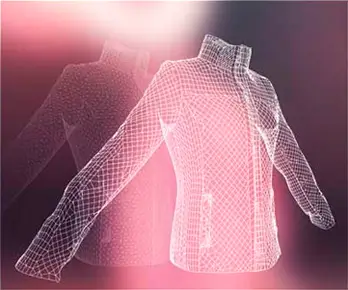 This will complete
the technical part of the
business model,
and we will be ready
to apply for a patent
and continue developing
the technology into
a marketable product.
After that, only operational execution remains —
websites, apps, warehouses, logistics,
and, of course, marketing. A project as ambitious
and impressive as this won’t go unnoticed.

Money
The capacity of the clothing retail market that
we intend to revolutionize is
$5,000,000,000,000
— five trillion dollars.
To save readers’ time, we won’t mention specific
total investment amounts for entire project.
It would be absurd to offer overly precise
predictions, but you can find detailed financial
plans up to 5 years in the Download section.
We’re inviting the wealthy to spearhead a global
market revolution. And the first step is $5M.
Join.
It’s going to be interesting.
And profitable for sure.

Futureshopping —
a shopping experience,
relevant to the future
try FITME prototype for free right now.
no sign-up needed


How does it work?
We are launching a high deep-tech fulfillment
marketplace capable of creating a precise digital
model of the human body via multidimensional
polygonal scanning. It sounds complicated,
but it’s extremely convenient for the user —
their smartphone tells them how to position
themselves in front of the camera and how to turn
to match the prompt on the screen.
In less than a minute, a detailed digital model
of the customer is ready.
Now, from any digital device, customers will
be able to browse a huge catalog of clothes,
footwear and accessories, and "try on" only those
items that fit them perfectly in motion.
Customers can see, in real time, in full size
and with all the nuances of the body type and fabric
accounted for, how the clothes they choose fit them
— even in motion. No competitor can provide such
a service today.
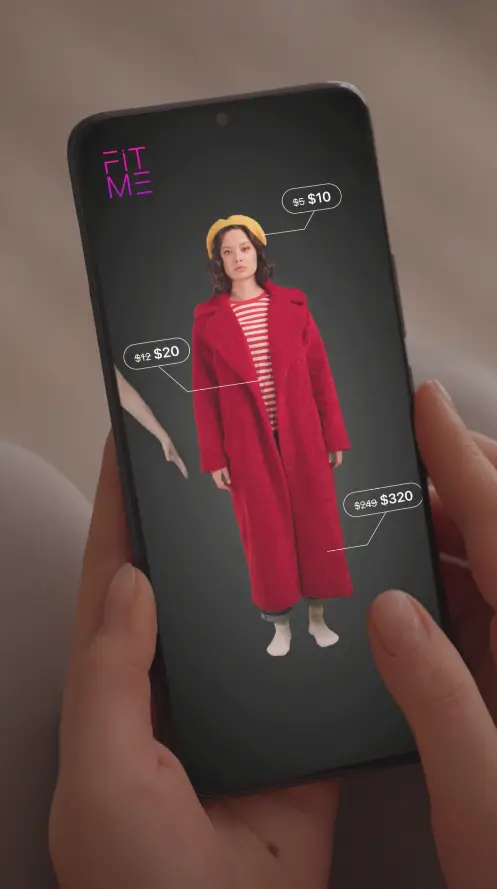
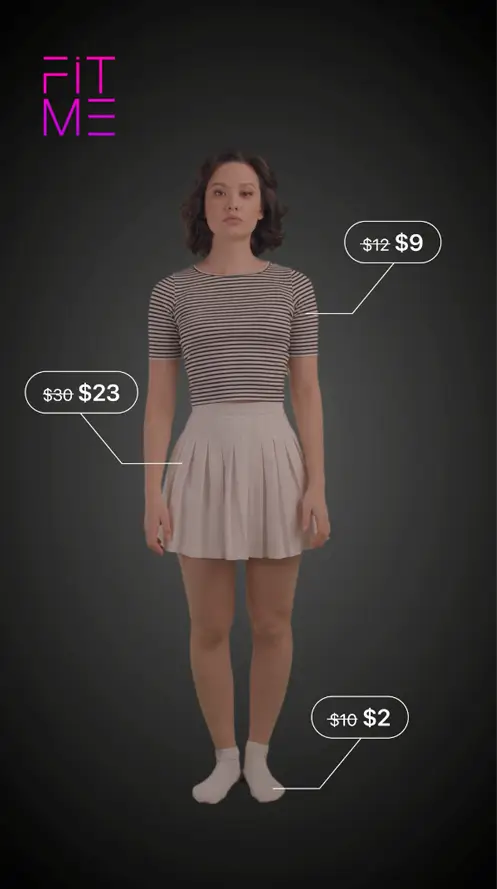
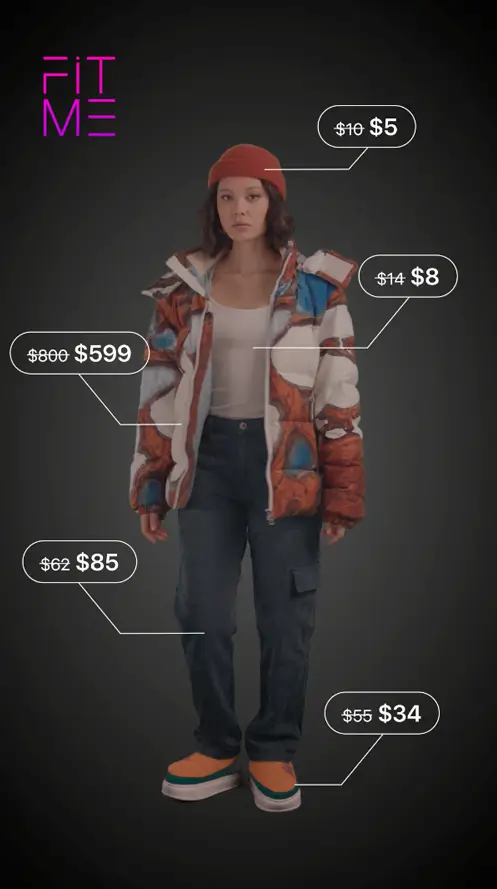
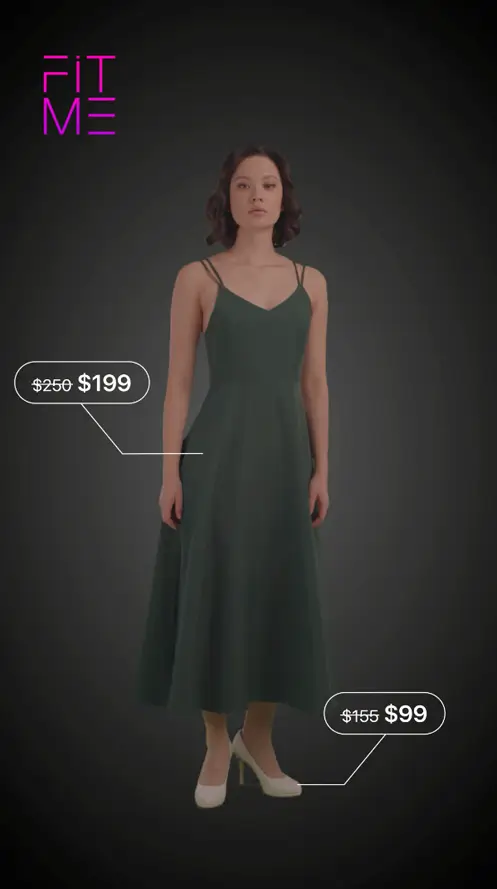
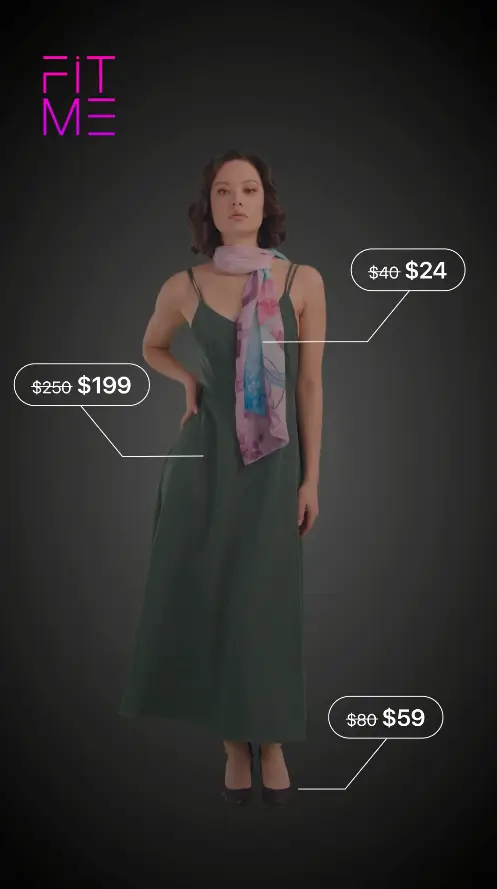
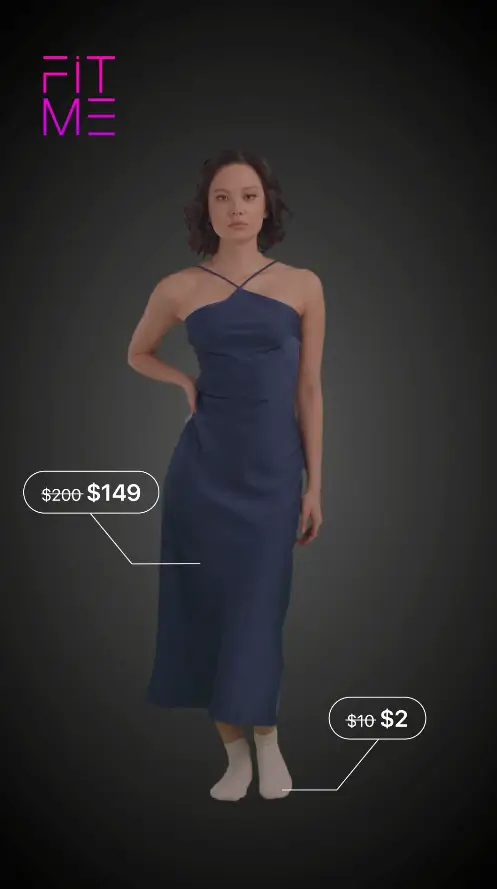
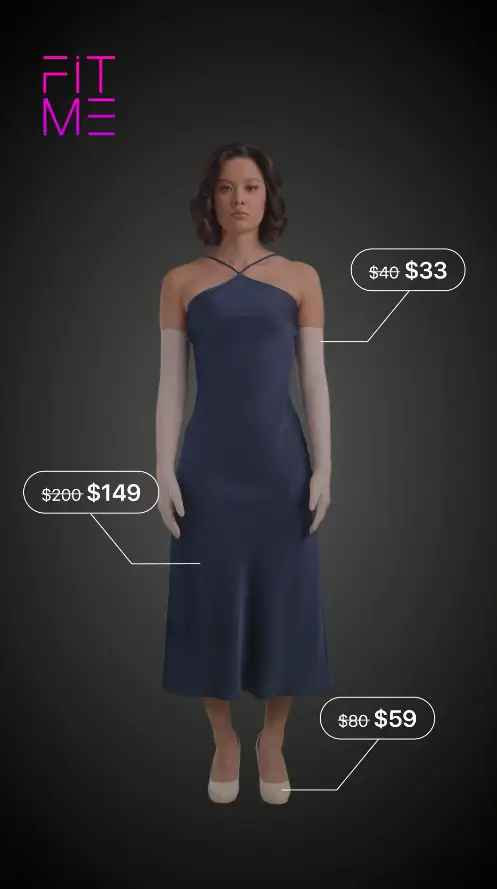
Using big data and AI, the system suggests outfit
combinations made only from items that fit perfectly.
The only thing left to do is choose (and share).
No perfect models in the clothing catalog —
only the real customer, in all their uniqueness.
Business has never been so personal and interactive — hyper-personalization as it should be.
The next step in the future would be to simply print
the apparel and in that case, we would already
be far better prepared than others, because we would
already have an audience and precise data on each
customer’s body shape.

From a business perspective, this sales model
assists, at the very least, in avoiding the payment
of exorbitant rent prices for mall premises,
or unreasonably high (when compared to their actual
output) staff costs — customers will be able to pick
out and «try on» clothes online, saving a whole lot
of precious time with just a few clicks.
After choosing an outfit (FITME will suggest items
in matching sets based on cultural preferences),
customers enter their delivery details, make payment,
and wait for their order to arrive at their address
or a pickup point.
Customers take charge of serving themselves
through online communication channels, and only
get the products that will definitely fit them —
FITME.
A “movie” about the new you powered by
a specialized AI layer for fashion
- Garment-to-garment compatibility
- Garments-to-user compatibility (style, budget
and body measurements for sure) - Region-specific aesthetic profiling
Customers get interactive hyper-personalized
recommendations from “stylists” (in quotes
because this role is primarily fulfilled by AI —
artificial intelligence guided by experienced
stylists and enriched with big data cultural
references — local movies, series, trends on social)
through the app, messengers, social media
or email — as often as they want.
Outfit recommendations will also take into
account previously purchased items.
For example, that pair of slacks you already own
will pair perfectly with this coat and this scarf —
check out how the outfit looks on you.
Everything is in stock, will be delivered tomorrow,
the discounted price of the set is $299.
Naturally, recommendations are generated
automatically. Stylists define the general rules
and then the system takes over: it generates
specific outfits and uses sales performance data
to improve on its own, creating combinations
that sell well — in ways no human could match.
Customers get access to a tool that allows
them to interact with their appearance
in a completely new way — a visual style builder.
After getting a taste of FITME, customers are
hooked — and it’s very hard to quit.
Simple psychological mechanism: dopamine hits
from “style revelations” (e.g., “I’d never have
paired this myself!”) create an addiction to FITME
creative authority.
After getting a taste of FITME, customers are
hooked — and it’s very hard to quit.
With FITME, they can mix and match new items
with the clothes they already own, right on their
phone or on the website / app, create new looks
and share them on social media.
Catalog items are unobtrusively labeled with
suggestions like “matches your skirt” / “shirt” etc.
And now the clincher:
Uploading an item bought elsewhere into the
virtual wardrobe is also an option.
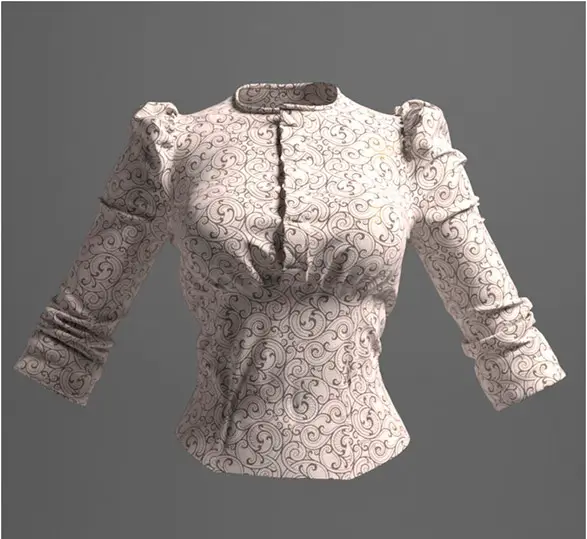
This power fashion AI-component makes FITME
not just another apparel marketplace with
countless filters and virtual fitting, even in motion,
but 24/7 style co-pilot in your pocket.
It’s the next killer feature of futureshopping.
— I have nothing to wear!
— Now you do. FITME.
Total automation
The only way to successfully implement a hyper-
technological business model like this is to ensure
comprehensive, ultimate automation of the entirety
of the global business — wherever possible,
replacing humans with machines and AI.
No “managers”, “operators”, “dispatchers” —
all business
processes are tightly automated.
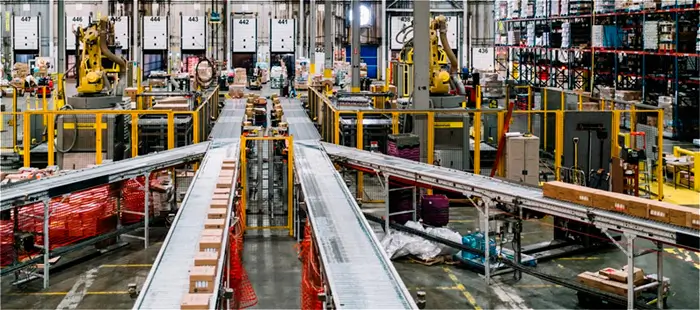
The good news is that we don’t need SAP for
a gazillion dollars (which, by the way, is not —
nor will it ever be — automated to this degree).
We have software solutions and experienced
professionals capable of accomplishing these
tasks in a much more practical way.
For example, the platform we plan to launch FITME
on, was previously used by Ulmart — a leader
in e-commerce across Russia and the CIS, with
a $1.3 billion in sales and a dayly transaction volume that required trillions of operations.
Blumart, the largest DIY hypermarket chain
in Russia (plumbing), also runs on this platform ($40M in sales).
The core of our IT team knows how to deal with
high-load and automate such businesses.
affordable prices
The catalog features a vast range of products from all brands — both old and new, fashionable and less so, catering to every style and budget.
The business model allows us to create a broad distribution channel, and as a result, suppliers can offer competitive rates.

In addition to favorable purchase prices, the revolutionary try-on technology and other advantages include:
- payroll savings due to full business automation (no unnecessary staff);
- no expensive retail space (no need to rent large premises);
- IT support comparable to that of any other mid-sized business.

Competition
So far, no one’s done anything like this.
virtual fitting in motion based on
real body measurements
and clothing fabric behavior
There have been some feeble attempts to create
so-called virtual dressing rooms, but what we’re
offering isn’t just another “dressing room” —
it’s the development of a breakthrough technology
that will disrupt several industries at once, and will
become the platform for launching an innovative
business model for clothing retail (to start with).
We are developing a specialized AI that works with
actual physical measurements — a real fitting based
on real data and not just pixels on pixels with
a heavy visual augmentations as today’s AI does.
Why can we create it? — The answer is here.

It’s not a real revolution without Che, is it?
The best place for
for the launch
Launching the startup in the United States.
The U.S., with its powerful economy,
well-developed logistics and receptive audience,
seems the most promising market.

For the headquarters
Simply because I’m Israeli and I want to support
my new-yet-old homeland. On top of that, Israel
has a world-class startup ecosystem.

For software development
I was born in Saint-Petersburg, Russia, and I have
a successful software development business there.
I know how to organize a highly effective
development hub there. Software development
costs in Russia would be two-three-four times
cheaper than in Israel or the U.S. while maintaining
extremely high quality and control.



I plan to make the most of each of my countries.